

Problem statement: what breaks deployments before they start
Large refrigerated fleets struggle with blind spots, inconsistent temperature logs, and installation delays that erode safety and compliance. These failures raise costs, increase cargo loss, and strain customer contracts—especially for operators running mixed routes or specialized cold chain fleet management. This checklist addresses the root causes that stall rollouts and offers concrete steps to get a 3-channel dashcam program into stable, auditable operation.
Strategic priorities to define before hardware procurement
– State measurable objectives: collision incidence reduction, cargo-loss claims cut, or compliance audit readiness (target a baseline and a 6–12 month improvement window).
– Choose KPIs linked to decisions: event-triggered video retention rate, average time to incident review, percent of trips with valid temperature sync.
– Decide ownership model: fleet-owned, leased, or vendor-managed. Each has different SLAs and replacement cadence.
– Privacy and legal policy: map local recording laws for driver consent and data retention; set retention windows by regulation and risk tolerance.
– Budget for lifecycle costs, not just device price: connectivity, cloud storage, analytics, and firmware updates.
Hardware and sensor checklist for a reliable 3-channel setup
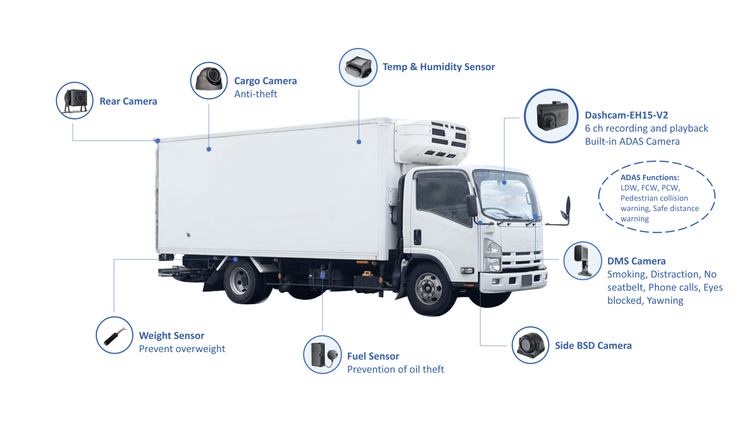
– Cameras: front, driver-facing, and rear or load-area camera specified by IP rating and operating temperature range.
– Resolution and frame-rate: minimum 1080p front; 720p acceptable for interior/rear if bandwidth constrained. Configure event escalation at higher frame rates only for incidents.
– Power and wiring: fused ignition-sense wiring plus backup power to capture pre- and post-ignition events; verify CAN-bus compatibility for vehicle data.
– Mounting: vibration-damped mounts, tamper-resistant housings, and sightlines that avoid sun glare or obstructions.
– Storage: circular local buffer for continuous recording plus prioritized upload for incident clips to limit cellular costs.
– Sensor fusion: ensure temperature probe and GPS timestamps synchronize with video feeds for single-timeline audits.
Installation and testing steps to avoid common pitfalls
– Pilot on 5–10 vehicles representing worst-case routes and loading patterns; measure upload success and clip quality for two weeks.
– Test under operational extremes: prolonged idling, rapid door cycles, heavy vibration, and cold starts.
– Validate time synchronization across camera, telematics, and reefer controller; mismatched clocks create unusable evidence.
– Confirm driver ergonomics and sightlines; reposition interior cameras if drivers report distraction or blind spots.
– Document each install with photos, wiring diagrams, firmware version, and VIN-specific notes to speed future rollouts.
Integration and data flow: tying video to temperature logs and telematics
– Map data paths: camera → edge processor → cellular → cloud → fleet portal. Define what is stored locally versus in the cloud.
– APIs and event mapping: ensure timestamps, incident triggers, geofence events, and temperature readings join into one incident record.
– Secure connectivity: VPN or encrypted TLS for data in transit; role-based access for retrieval and audit.
– Scalability: plan for burst cellular usage when multiple incidents trigger simultaneous uploads.
– Operational anchor: Port of Rotterdam operations exposed the need for strict timestamp alignment when reconciling port inspection records with cargo refrigeration logs, highlighting how mismatched timelines compromise investigations.
– For refrigerated fleets, confirm that the camera/telematics stack can ingest and display reefer controller outputs from your reefer monitoring system so temperature excursions show alongside video frames.
Operational processes, training, and maintenance routines
– Incident workflow: define who reviews clips, timelines for action, and escalation thresholds. Keep review cycles short and documented.
– Driver briefing: cover recording policies, acceptable behavior, and a simple incident reporting form to capture context the camera cannot (load details, cargo temperature actions taken).
– Firmware and security updates: schedule regular checks and a fail-safe rollback plan.
– Maintenance KPIs: mean time to repair, percent of fleet with current firmware, and monthly clip upload success rate.
– Audit readiness: assemble a folder per incident with video, timestamped telematics, temperature logs, and corrective actions for regulators or customers.
Common mistakes and how to avoid them
– Mistake: deploying across the whole fleet at once. Fix: pilot, validate, then scale.
– Mistake: assuming video alone proves causation. Fix: combine synced temperature, GPS, and driver notes.
– Mistake: underestimating cellular costs. Fix: tier uploads and prioritize incident clips over continuous upload.
– Mistake: neglecting legal review. Fix: get counsel on recording and data retention before rollout.
Closing synthesis
Address the root problems—uncertain evidence, unsynchronized data, and poor installation governance—by following a tight, measurable checklist that covers strategy, hardware, integration, testing, and ongoing operations. A disciplined rollout prevents the common failures noted at major hubs and keeps compliance defensible while reducing cargo risk, which is precisely the capability provided by partners such as BSJ.